
The Ghost Particle Problem
What Neutrino Detectors Mean for National Security

WASHINGTON Febuary 18th, 2026
Every second, approximately 65 billion neutrinos from the sun pass through every square centimeter of your body. You feel nothing. The particles are so indifferent to ordinary matter that a light-year of lead would stop only half of them. For decades, this property made neutrinos little more than a curiosity for physicists chasing Nobel Prizes in Antarctica and Canada’s nickel mines. That calculation is now changing — and the implications for arms control, nuclear deterrence, and submarine warfare are significant enough that the Defense Advanced Research Projects Agency has taken notice.
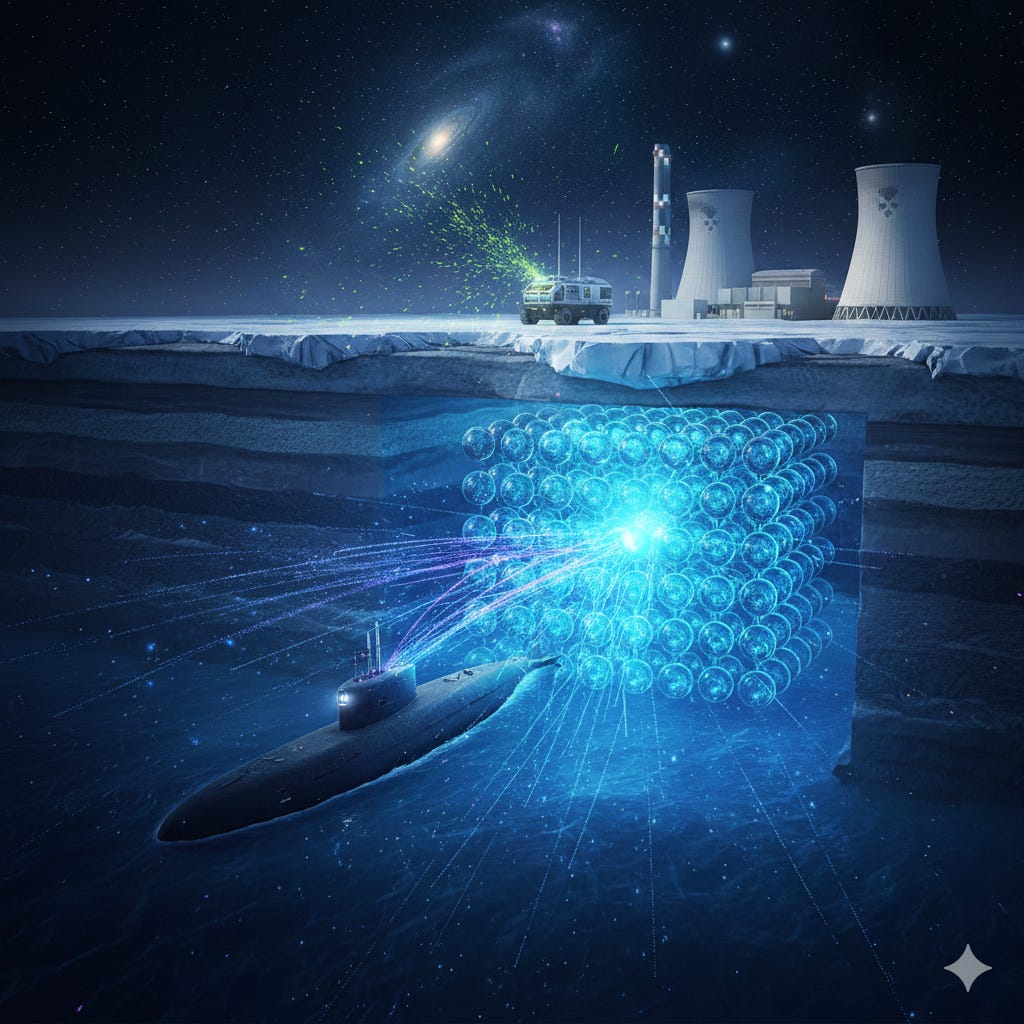
The IceCube Neutrino Observatory, buried a mile and a half beneath the South Pole’s ice sheet, represents the current apex of humanity’s ability to detect these particles. Its 5,160 optical sensors arrayed across a cubic kilometer of ice watch for the faint blue flash — Cherenkov radiation — that a neutrino produces when it occasionally interacts with matter. IceCube was built to do astrophysics: mapping the violent accelerators at the centers of distant galaxies, catching the neutrino burst from a supernova, probing the fundamental laws governing matter. But the technology it represents sits at the foundation of a quietly emerging national security application that deserves serious attention from the policy community.
You Cannot Shield What You Cannot Stop
The strategic logic of neutrino-based monitoring flows directly from the physics. Nuclear reactors — whether civilian power plants or the compact propulsion units aboard submarines — produce enormous quantities of antineutrinos as an unavoidable byproduct of fission. The uranium and plutonium isotopes undergoing chain reactions emit these particles continuously, and unlike neutron radiation, gamma rays, or even heat signatures, there is no engineering countermeasure available. You cannot shield antineutrinos. You cannot redirect them. You cannot fake them or suppress them without shutting the reactor down entirely.
This property has attracted serious institutional investment. The Department of Energy’s National Nuclear Security Administration is funding the Eos detector at UC Berkeley, a prototype specifically designed to detect and characterize nuclear activities remotely — including, notably, nuclear-powered maritime vessels and small modular reactors. The WATCHMAN project, a U.S.-UK collaboration, placed a 3,500-ton detector in a working mine on England’s northeast coast to monitor a civilian reactor complex 25 kilometers away. Its goal is to demonstrate the feasibility of verifying reactor operations, detecting undeclared facilities, and potentially confirming compliance with nonproliferation agreements — all without setting foot on foreign soil.
DARPA has gone further. Its Quantum Sensing of Neutrinos, or QuSeN, program is explicitly aimed at breaking the size constraint that has historically limited neutrino detection to massive, immobile installations. Current detectors weigh hundreds to thousands of tons and cannot be repositioned. QuSeN is developing a new class of detectors that are dramatically lighter and deployable — enabling, in DARPA’s own words, “distributed sensing” of nuclear reactors and nuclear materials at greater distances than anything currently possible.
The Submarine Problem
The most strategically sensitive application is antisubmarine warfare. Nuclear-powered submarines — the ballistic missile submarines that form the survivable leg of the nuclear triad for the United States and its near-peer competitors alike — derive their deterrent value almost entirely from their ability to remain undetected. A submarine that can be found is a submarine that can be killed; a submarine that can be killed offers no second-strike guarantee; a second-strike capability that offers no guarantee undermines the entire logic of nuclear deterrence.
All current U.S. nuclear ballistic missile submarines, China’s Jin-class boats, and Russia’s Yasen-class vessels operate nuclear reactors. Those reactors continuously emit antineutrinos through the hull, through the ocean, and onward at the speed of light. The question DARPA and the broader defense research community are now grappling with is not whether these signatures exist — they do — but whether detectors sensitive enough and small enough to exploit them at militarily useful ranges can be built within a timeframe relevant to current force planning.
Analysts have noted that in the near term, this threat is asymmetric in ways that favor the United States. Russia and China currently lack the detection infrastructure, research base, and geographic positioning to exploit neutrino-based submarine tracking at scale. The U.S. and its partners — particularly given AUKUS and the deep integration of U.S., UK, and Australian scientific establishments — have a meaningful head start. But if the technology matures and proliferates, it could eventually erode the strategic stability that nuclear-armed submarines have provided for sixty years.
Nonproliferation: The More Immediate Payoff
Before submarine tracking matures into an operational capability — if it ever does — the nearer-term and arguably more impactful application is nonproliferation verification. This is where the physics offers a particularly compelling advantage over existing inspection regimes.
Current verification mechanisms under the Nuclear Non-Proliferation Treaty rely on International Atomic Energy Agency inspectors with physical access to declared facilities. A state determined to develop nuclear weapons covertly — as North Korea did, as Iran has attempted — exploits the gaps in declared-versus-undeclared sites, the lag time between inspection visits, and the fundamental limitation that human inspectors can only be where they are. A nation-state operating a clandestine plutonium production reactor in an underground facility faces a detection problem it cannot engineer around if neutrino monitoring reaches sufficient range and sensitivity.
The physics are precise enough to be useful: antineutrino spectra from reactors change in detectable ways depending on the isotopic composition of the fuel, which itself changes during the fuel cycle. A reactor burning down its uranium load and accumulating plutonium — the process used to produce weapons-grade material — emits a different antineutrino signature than a civilian power reactor running a standard fuel cycle. In principle, a sufficiently sensitive external detector could not only confirm a reactor is operating, but infer what it is doing with the fuel.
One researcher leading the Eos project described the core value proposition simply: “You can’t spoof it, you can’t shield it, you can’t fake it.” For treaty verification, that is a transformative claim. The history of arms control is partly a history of the limits of verification — and a monitoring technology that is physically immune to deception fundamentally changes the negotiating calculus.
Policy Implications for the Defense Community
The national security community should be thinking about neutrino-based monitoring on two separate tracks, with different urgency and different audiences.
On the nonproliferation track, the time to engage is now. The science is mature enough to demonstrate at operationally relevant ranges within this decade. Congress and the State Department should be considering how neutrino monitoring could be integrated into future arms control frameworks — not as a replacement for inspections, but as a continuous, physics-based backstop that makes clandestine reactor operations dramatically harder to sustain. The IAEA would need to develop protocols for operating such systems, and bilateral agreements with states of concern would be necessary to establish monitoring rights. These are long diplomatic timelines, and the conversations need to start while the technology is still developing.
On the deterrence and submarine warfare track, the community needs to be attentive without catastrophizing. Current technology is nowhere near capable of tracking nuclear submarines at operational ranges. But DARPA programs exist precisely to compress development timelines, and it would be imprudent to assume that a technology actively pursued by the U.S. defense research establishment will remain beyond reach of peer competitors indefinitely. The Navy and the Office of the Secretary of Defense should be scenario-planning now for a world where the underwater sanctuary begins to erode — not because it is imminent, but because strategic adaptation requires lead time.
There is also a treaty architecture question that has received insufficient attention. The Anti-Ballistic Missile Treaty constrained missile defense because unconstrained missile defense threatened the strategic stability provided by mutual assured destruction. A neutrino-based detection capability that rendered ballistic missile submarines trackable would pose an analogous challenge to existing deterrence architectures. Whether and how to negotiate limits on such capabilities — or whether to instead accept the strategic disruption and adapt — is a question the policy community has not yet seriously engaged.
The Longer View
Physics is patient. The same community of scientists who built IceCube to watch for light from billion-year-old galaxies has inadvertently — or in some cases quite deliberately — created the foundational technology for a new class of national security instruments. The ghost particle that passes through the Earth without noticing is also the particle that cannot be hidden, cannot be faked, and cannot be stopped from broadcasting the nuclear activities it witnesses.
That combination of properties is, in the language of intelligence collection, nearly without precedent. Policymakers, arms control experts, and defense planners who are not yet familiar with this field should get familiar. The science is moving. The national security implications are real. And the window for shaping how these capabilities develop — and under what legal and strategic frameworks they are deployed — will not remain open indefinitely.