
Beyond Maxwell’s Limits
From the Catastrophic Plasma of Railguns to the Non-Linear Metamaterials of Active Cloaking

Abstract
The evolution of military electromagnetic technology sits at a fault line between two very different kinds of hard problem. On one side is theoretical electrodynamics — a body of physics that has been essentially settled since the 1860s. On the other is extreme materials engineering, a field that is still, in a very real sense, catching up to what the equations say should be possible. This paper explores two frontiers that sit on opposite sides of that fault line.
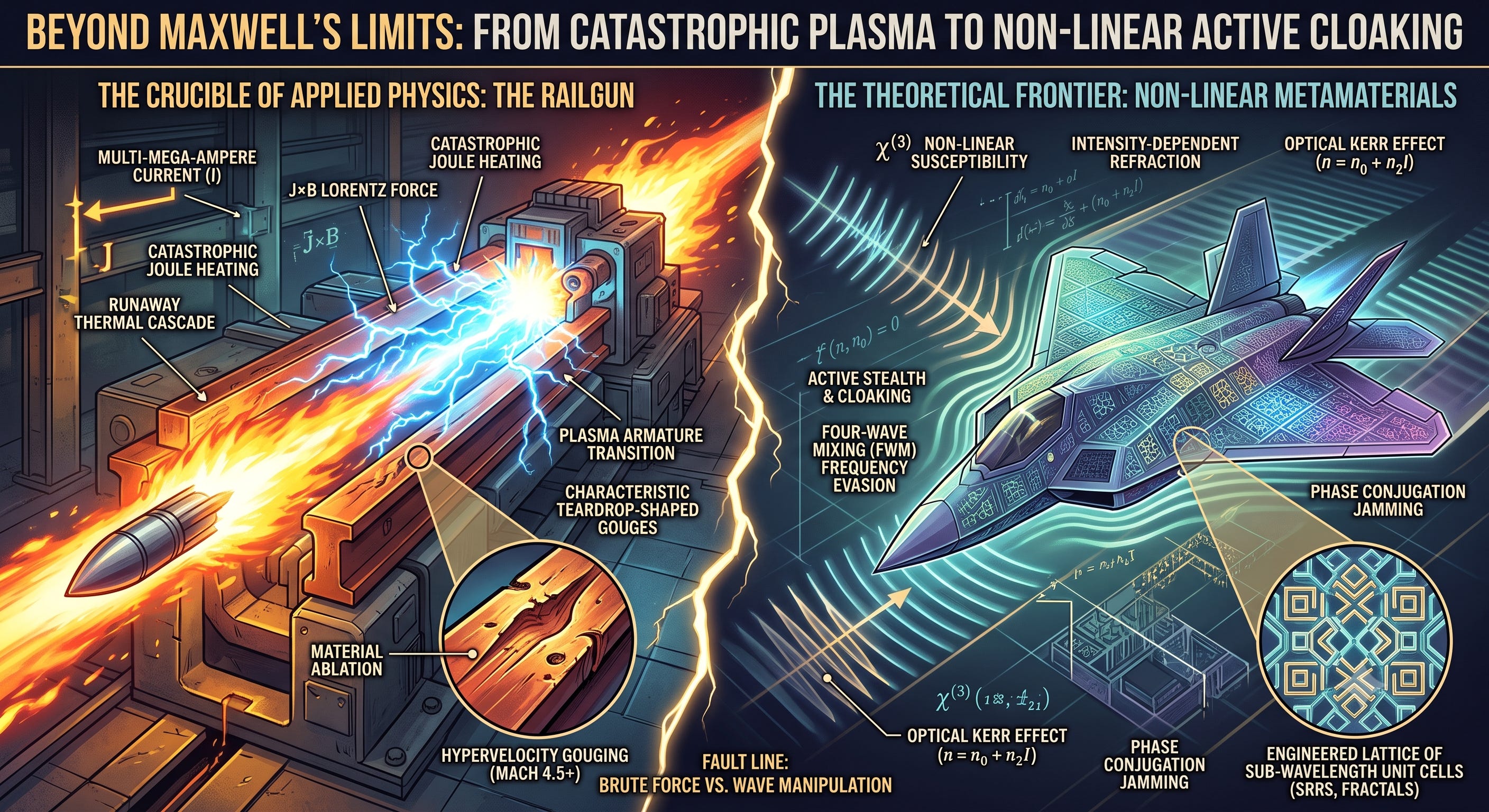
First, we examine the brutal thermodynamic and mechanical constraints of electromagnetic railguns: the transition from solid armature to plasma armature, the runaway thermal cascade driven by Joule heating, and the hydrodynamic gouging that occurs once sliding contact velocities pass roughly Mach 4.5. Here, the physics is simple — the engineering is what fights back.
Second, we turn to the opposite problem: the deliberate manipulation of wave propagation through non-linear metamaterials. By exploiting third-order non-linear electric susceptibility (χ⁽³⁾), engineered surfaces can make the refractive index of a material a function of the intensity of the wave hitting it. That single fact — intensity-dependent refraction — is the seed from which active stealth, frequency-shifting radar evasion, and phase-conjugate jamming all grow.
Together, these two case studies illustrate the two ways a defense technologist can push against Maxwell’s equations: by brute-forcing more current and more force through a system until the materials fail, or by rewriting how a material responds to the field in the first place.
1. Introduction
Modern defense electromagnetics tends to bifurcate into two philosophies, and it’s worth being explicit about what separates them, because the failure modes are completely different.
Philosophy one: raw kinetic and directed energy. The theory here is not in question — anyone with an undergraduate electrodynamics textbook can derive the force on a current-carrying conductor in a magnetic field. What stands between the equation and a working weapon is the universe’s tolerance for extreme current density, extreme heat, and extreme mechanical stress. Electromagnetic railguns are the purest expression of this philosophy: conceptually simple, ferociously hard to build something that survives its own operation.
Philosophy two: manipulating the medium itself. Here the engineering — depositing sub-wavelength structures with nanometer-scale precision — is the easy part relative to the theory. The physics pushes into exotic territory: linear electrodynamics gives way to non-linear polynomial expansions, negative refractive indices, and wave-mixing phenomena that have no analogue in the classical intuition most engineers grow up with. Non-linear metamaterials are the purest expression of this second philosophy.
This article walks through both domains in depth, treating the railgun as a case study in what happens when you push a well-understood system past its material limits, and non-linear metamaterials as a case study in what happens when you redefine the system’s governing equations before you ever apply a volt.
2. The Crucible of Applied Physics: Surviving the Railgun
2.1 The Governing Force
A railgun is, at its conceptual core, almost insultingly simple. Two parallel conductive rails carry current to a sliding armature; the current loop generates a magnetic field; the field acts on the current-carrying armature via the Lorentz force. Integrated over the volume of the armature, that force is:
F = ∫ (J × B) dV
where J is the current density and B is the magnetic field generated largely by the current in the rails themselves. To push a projectile to hypersonic velocities — typically cited in the Mach 6–7 range for full-scale systems — the driving current must reach into the multi-mega-ampere range. It is worth sitting with that number: modern high-voltage transmission lines carry current in the low thousands of amps. A railgun shot can momentarily draw a thousand times that, for a few milliseconds, through a conductor a few centimeters across.
That mismatch — enormous current, tiny conductor, tiny time window — is the entire story of why railguns are hard.
2.2 Catastrophic Joule Heating
The first wall every railgun design runs into is thermal. Resistive (Joule) heating scales with the square of current:
P = I²R
At mega-ampere currents, even a resistance on the order of a milliohm — smaller than the resistance of a few centimeters of household wire — produces a power dissipation in the tens of megawatts, delivered in a pulse lasting only milliseconds. Because the pulse is so short, the heat has no time to conduct away into the bulk of the rail; it stays localized at the sliding interface, and that interface is precisely where two more problems compound the situation:
Contact resistance is never perfectly uniform. Microscopic surface irregularities mean the armature never touches the rail across its full nominal contact area — current is forced through a shifting patchwork of tiny real contact points, each carrying current density far above the average.
Skin effect and current diffusion. At the frequencies implicit in a millisecond-scale current pulse, current does not distribute evenly through the rail’s cross-section; it concentrates near the surface, further raising the effective current density exactly where erosion is worst.
The result is micro-arcing at the contact points, and the localized temperature at those points blows past the melting point and then the vaporization point of the rail and armature alloys (typically copper alloys for the rails, aluminum or copper-graphite composites for the armature) almost instantaneously. What began as a solid-on-solid sliding contact becomes, mid-shot, a thin sheet of highly energetic, electrically conductive plasma wedged between armature and rail.
2.3 The Plasma Armature Transition
This transition changes the physics of the weapon mid-shot, which is part of what makes railgun engineering so unforgiving — the system you’re modeling at t=0 is not the system you have at t=3ms.
The plasma layer remains conductive, so it continues to carry current and continues to be accelerated by the J × B force — in that sense, the gun still “works.” But a plasma sheet behaves nothing like a solid armature:
It is compressible and can develop instabilities (restrike, secondary arcing behind the primary armature) that create additional, uncontrolled current paths.
It acts thermodynamically like a blowtorch aimed continuously at the rail surface, driving a runaway heating cycle: more plasma → more localized heating → more rail material ablated into the plasma → more plasma.
The energy that goes into vaporizing rail and armature material is energy that does not go into accelerating the projectile — plasma armature transition is a direct efficiency loss, not just a durability problem.
Repeated firing compounds this: each shot ablates a small amount of rail material, roughening the bore surface and making the next shot’s contact even less uniform. This is the central reason railgun barrel life has historically been measured in the hundreds of shots rather than the tens of thousands expected of conventional gun barrels.
2.4 Hypervelocity Gouging
Independent of the thermal story, there is a purely mechanical failure mode that only appears once the armature’s sliding velocity crosses a threshold — commonly cited around 1.5 km/s, or roughly Mach 4.5.
Below that threshold, the rail-armature interface behaves the way ordinary sliding friction behaves: elastic and plastic deformation, wear, but a recognizably “solid-on-solid” mechanical picture. Above it, the interface stops behaving like two solids and starts behaving like a solid plowing through a viscous fluid. This is hypervelocity gouging, and it is a hydrodynamic — not mechanical — phenomenon: at those velocities, the timescale of the interaction is shorter than the timescale over which the rail material can respond elastically, so the material behaves as though it has no shear strength at all.
The practical consequence is that the armature doesn’t so much slide over the rail as excavate it, tearing characteristic teardrop-shaped gouges out of the rail surface, oriented along the direction of travel. Each gouge:
Destroys the smooth aerodynamic profile of the bore, disturbing the sabot/projectile interface for every subsequent shot.
Introduces localized regions of increased contact resistance (the very irregularity that seeds more Joule heating and more arcing on the next shot).
Represents permanent, non-repairable material loss from the bore surface.
Gouging and plasma-driven Joule heating are thus not two independent failure modes — they are mutually reinforcing. Every shot that produces gouging makes the next shot’s thermal problem worse, and every shot with worse thermal ablation leaves a rougher surface that gouges more severely. This feedback loop is the fundamental reason barrel life, rather than energy storage or power electronics, has historically been the pacing item for railgun maturation programs.
2.5 Why This Matters Beyond the Barrel
It is worth noting that none of this is a solvable-by-brute-force problem in the way, say, “make the capacitor bank bigger” is solvable. More energy delivered faster makes both the thermal and the hydrodynamic problems worse, not better — which is why so much of the applied materials science in this space (refractory rail coatings, graded conductivity armatures, augmented rail geometries that reduce peak current density) is aimed not at achieving higher muzzle velocity, but at surviving the velocity the system already produces.
3. The Theoretical Frontier: Non-Linear Metamaterials
3.1 Where Linear Electrodynamics Breaks Down
If the railgun is what happens when you push a linear, well-understood system past its material limits, non-linear metamaterials are what happens when you deliberately design a system so that the linear description was never adequate to begin with.
Ordinary dielectric materials are described by a simple proportionality between the applied electric field E and the resulting electric displacement field D:
D = ε₀E + P = εE
This is the assumption underlying essentially all of classical optics and antenna theory: double the field, double the polarization response. It holds extremely well for ordinary materials at ordinary field strengths. It stops holding — by design — inside engineered metamaterials, structures built from sub-wavelength unit cells (split-ring resonators, nanoscale rod arrays, layered dielectric stacks) whose geometry, not their bulk chemistry, determines their electromagnetic response. Because these structures are smaller than the wavelength of the radiation they’re built to manipulate, the material can be treated as an effective medium with electromagnetic properties — permittivity, permeability, and now non-linearity — that don’t exist in any naturally occurring bulk substance.
3.2 The Non-Linear Susceptibility Expansion
At high field intensities, the polarization response of such an engineered medium can no longer be captured by a single linear term. Instead, it must be expanded as a power series in the applied field, with each term weighted by a corresponding order of the material’s electric susceptibility, χ:
P = ε₀ ( χ⁽¹⁾E + χ⁽²⁾E² + χ⁽³⁾E³ + ... )
Each term in this expansion corresponds to a physically distinct phenomenon:
χ⁽¹⁾ is ordinary linear optics — the term that reduces the whole expression back to D = εE when the higher-order terms are negligible.
χ⁽²⁾ governs second-order effects such as second-harmonic generation, but it is only non-zero in materials that lack inversion symmetry — a structural constraint that rules it out for many otherwise-convenient metamaterial geometries.
χ⁽³⁾, the third-order term, is where the most operationally significant effects live, because unlike χ⁽²⁾ it is allowed in centrosymmetric materials, making it far easier to engineer into a practical structure. This is the term this paper focuses on.
3.3 The Optical Kerr Effect
Because the χ⁽³⁾ term scales with E³, and intensity I is proportional to |E|², a material with significant third-order susceptibility exhibits a refractive index that is itself a function of the intensity of the light or radar wave striking it:
n(I) = n₀ + n₂I
where n₀ is the ordinary, intensity-independent refractive index, and n₂ — the nonlinear refractive index — is proportional to χ⁽³⁾. This is the Optical Kerr Effect, and it is the single fact from which every application in the rest of this section follows. A Kerr-active metamaterial is not a fixed optical/RF element with one refractive index; it is a dynamic one, whose response depends on how strongly it’s being illuminated at any given instant.
3.4 Applications: Active Stealth and Electronic Warfare
The operational implications of intensity-dependent refraction are substantial, and they fall into three broad categories.
Dynamic refraction toward negative-index behavior. As a high-power radar beam illuminates a Kerr-active metamaterial skin, the local intensity of the field alters the local refractive index in real time. With a carefully engineered lattice, this can be pushed to the point of achieving an effectively negative refractive index (n < 0) in the illuminated region — a regime with no naturally occurring analogue, in which the material bends incoming radiation around the object rather than reflecting or scattering it back toward the receiver. Because the effect is intensity-dependent, the material’s response can in principle be strongest exactly where the illuminating radar is strongest, giving a self-adjusting cloaking behavior rather than one tuned to a single fixed angle or frequency.
Four-wave mixing (FWM) for frequency evasion. The same χ⁽³⁾ non-linearity that produces the Kerr effect also permits four-wave mixing: if an incoming (enemy) radar frequency and an onboard “pump” wave are both present in the non-linear medium simultaneously, they mix to generate new frequency components that were present in neither original signal. Practically, this allows a reflected radar return to be shifted outside the frequency band the illuminating receiver is listening on — the target is still reflecting energy, but not at a frequency the adversary’s receiver is built to detect. This is fundamentally different from radar-absorbent material (RAM), which tries to minimize the total reflected energy; frequency-shifting instead redirects the reflected energy somewhere the listener isn’t looking.
Phase conjugation as material-level jamming. Certain non-linear interactions allow a material to generate a phase-conjugate wave — one whose wavefront is the time-reversed mirror of an incoming distorted wave. A surface capable of phase conjugation doesn’t just fail to return a clean radar echo; it can actively return a wave engineered to interfere destructively with the illuminating signal’s own return path, functioning as a form of jamming embedded in the skin of the platform itself rather than in a separate emitter.
3.5 The Engineering Reality Behind the Theory
It’s worth being honest about where the theory currently outruns the hardware. Kerr-effect nonlinearity in most engineered materials is weak, meaning the field intensities required to produce a militarily useful shift in refractive index are often far higher than the intensities present in ordinary illuminating radar. Much of the active research in this space is really about maximizing n₂ — through resonant metamaterial geometries, exotic semiconductor heterostructures, and engineered defect states — so that useful non-linear behavior can be triggered at realistic, rather than laboratory-only, field strengths. In that sense, non-linear metamaterials sit at the same kind of frontier the railgun does: the equations describe a capability that is not in dispute, and the entire open question is whether materials science can be pushed far enough to realize it at a practical scale.
4. Conclusion
The dual study of extreme kinetic electromagnetics and non-linear metamaterials traces the full spectrum of what “defense physics” means today. The railgun is a story about a linear, well-understood system meeting the brutal, nonlinear realities of plasma thermodynamics and hydrodynamic material failure — a case where the equations were solved a century ago and the entire remaining challenge is materials engineering. Non-linear metamaterials invert that story: here, the materials engineering (sub-wavelength lithography, resonant structure design) is comparatively mature, and the frontier is in exploiting exotic mathematics — negative refractive indices, frequency mixing, phase conjugation — that have no precedent in classical intuition.
One domain weaponizes Maxwell’s equations through sheer force. The other weaponizes the underlying mathematics of wave propagation itself. Taken together, they point toward a defense-technology landscape in which the boundary between “what the physics allows” and “what the platform can survive or exploit” is being pushed from both directions at once — and where the next generation of capability will likely come not from choosing one philosophy over the other, but from the intersection of the two: materials that can survive extreme energy delivery and actively reshape how that energy — or an adversary’s — propagates through space.
🫡